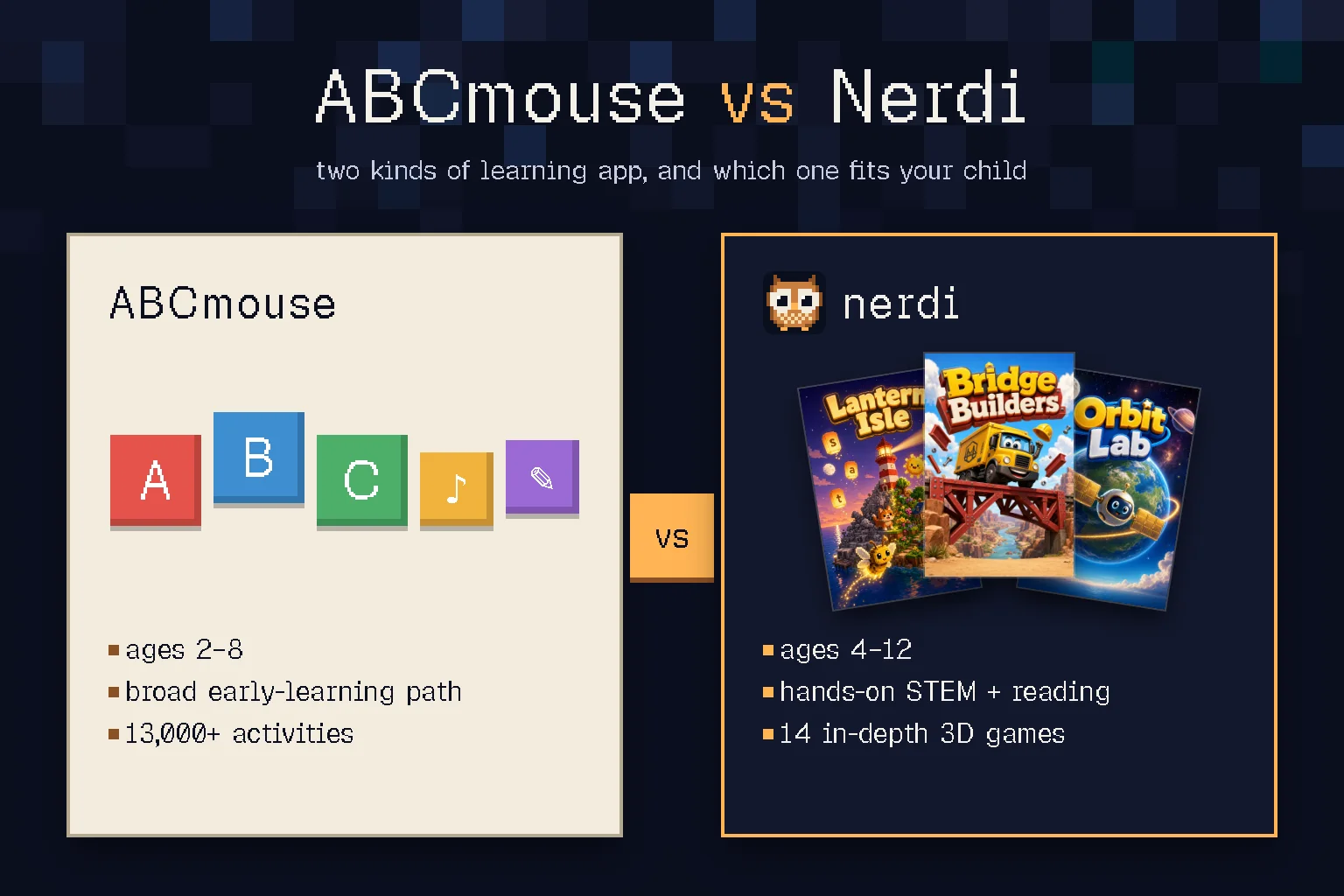
The short answer: ABCmouse and Nerdi are built for different jobs. ABCmouse is a broad early-learning program for ages 2 to 8, with thousands of learning activities across every subject, a step-by-step learning path and progress reports for parents. Nerdi is a smaller shelf of in-depth 3D science, technology, engineering, math and reading games for ages 4 to 12, where children learn by building, testing and fixing things. For a toddler or preschooler who needs all-round basics, ABCmouse is the more complete choice. For a school-age child who loves to tinker, or who has outgrown ABCmouse, Nerdi goes deeper.
A note before we start: we make Nerdi, so we aren't neutral. We've tried to be fair, to describe ABCmouse in its own words, and to link to its pages so you can check every claim. Prices and features are as of November 2026.
ABCmouse vs Nerdi at a glance
| ABCmouse | Nerdi | |
|---|---|---|
| Ages | 2 to 8 (preschool to 2nd grade)1 | 4 to 124 |
| Subjects | Reading and writing, math, science, social studies, art, music, logic1 | Science, technology (coding), engineering, math, reading |
| How much there is | 13,000+ learning activities and 450+ stories1 2 | 14 in-depth games, 5 to 30 minutes per sitting |
| Style | Activities along a guided learning path, plus free exploration | Open 3D worlds where the science or math is how you play |
| Rewards | Tickets earned for activities, spent on avatar items and digital pets2 | No currency or collectibles; progress in the game is the reward |
| Child accounts | Up to 3 child profiles with avatars1 | None; children never sign in4 |
| Progress for parents | Parent portal with progress tracking; detailed reports as an add-on1 2 | No parent dashboard; progress is saved in the browser4 |
| Devices | App on phones and tablets (not mobile browsers); browser on computers3 | Any modern browser on tablets and computers; nothing to install |
| Ads | None1 | None4 |
| Price | $14.99/month or $79.99/year1 | $15/month or $150/year |
| Free option | 30-day free trial; free Basic plan with up to 10 activities a day1 | 5 complete games free, one per subject, with no sign-in |
What is ABCmouse?
ABCmouse, made by Age of Learning, is one of the best-known early-learning programs. Its curriculum "grows with your child from ages 2 to 8" across reading and writing, math, science, social studies, art, music, and logic and reasoning.1 Premium members get more than 13,000 learning activities, personalized learning paths in reading and math for up to three children, and a library of over 450 stories.1 2
Children follow a learning path that "starts with simple concepts and progressively advances,"2 or explore freely. They earn Tickets for finishing activities and spend them on items for their avatar and digital pets.2 Parents get a portal with progress tracking and recommendations.1
What is Nerdi?
Nerdi is a hand-picked shelf of 14 learning games for children aged about 4 to 12, covering science, technology, engineering, math and learning to read. Each game is a 3D world built around one idea: children build bridges and watch which beams strain or snap under a truck, launch satellites to see why things stay in orbit, wire circuits to light up a city, or read words aloud to wake up a sleepy island.
Children never sign in. There are no ads, no chat and nothing to buy inside a game, and one game in every subject is free for anyone, with no account at all.4
The key differences
1. Age range: who each one is really for
ABCmouse runs from preschool to 2nd grade.1 Nerdi starts at about 4 and goes up to 12, and most of its games are aimed at children of 6 and up. The overlap is roughly ages 4 to 8. Below that, ABCmouse is the natural fit; above it, children have usually outgrown ABCmouse, and Nerdi's engineering, coding and physics games have room to stretch them.
2. Breadth versus depth
ABCmouse is broad: thousands of activities touching every early-learning subject, including art, music and social studies, which Nerdi doesn't cover. Nerdi is deep: far fewer games, but each one is a whole world where a sitting is often 15 to 30 minutes, returning to harder levels as skills grow. If you want one program to cover the basics of everything, choose breadth. If you want a child to really understand how a bridge carries weight or how an orbit works, choose depth.
3. How children learn
ABCmouse teaches mostly through guided activities: games, puzzles, songs and books arranged in a sequence. Nerdi teaches through what researchers call "learning by doing": the concept is the gameplay, and a mistake shows you why it went wrong, so you try again. A large meta-analysis of educational games found that how a game is designed makes a measurable difference to what children learn, while more realistic graphics on their own don't add much.5 Both approaches have their place: sequenced practice is efficient for early literacy and numeracy, while hands-on simulation suits science and engineering ideas that are hard to see on a page.
4. Rewards and motivation
ABCmouse motivates with Tickets, avatars and digital pets.2 Many young children love this, and it keeps them coming back. Nerdi deliberately has no currency or collectibles: the reward is the bridge holding, the satellite staying in orbit or the island lighting up. Which works better depends on your child, but if you'd rather they didn't play for prizes, that's a real difference.
5. Accounts, privacy and safety
Both are ad-free.1 4 ABCmouse gives each child a profile and avatar, which is what makes its personalized paths and progress reports possible.1 Nerdi takes the opposite approach: children have no accounts and give no information. A grown-up signs in only to unlock the paid games, and the one game that can use the microphone checks words on the device without recording them.4
6. Progress tracking
This is where ABCmouse is clearly ahead. Its parent portal shows progress, recommendations and usage insights, with detailed reports and assessments available as an upgrade.1 2 Nerdi has no parent dashboard: each game remembers progress in the browser on that device, and that's all. If you need to see exactly what your child has practised, ABCmouse does that and Nerdi doesn't.
7. Devices
ABCmouse needs its app on phones and tablets; it isn't supported in mobile browsers.3 Nerdi runs in the browser on tablets and computers with nothing to install, so it works on a school laptop, a Chromebook or a shared family computer without app-store downloads.
Price: what each one costs
| ABCmouse | Nerdi | |
|---|---|---|
| Monthly | $14.99 | $15 |
| Yearly | $79.99, auto-renewing | $150 |
| Try before you pay | 30-day free trial | 5 full games free, no sign-in, no time limit |
| Free plan | Basic: up to 10 activities a day, one child1 | The 5 free games |
| Refunds and cancelling | Prepaid and non-refundable; access continues to the end of the period3 | Cancel any time from your account; access continues to the end of the period |
Month to month they cost about the same. On a yearly plan ABCmouse is cheaper, and it often runs promotions on top of that.1 The bigger question is which one your child will actually use: a subscription a child has outgrown is expensive at any price.
Which should you choose?
Choose ABCmouse if:
- your child is 2 to 6 and you want one program covering reading, math, art, music and more;
- you want a guided, step-by-step path and progress reports you can check;
- you're setting up profiles for several young children;
- your child is motivated by collecting rewards and dressing up an avatar.
Choose Nerdi if:
- your child is 6 to 12, or has outgrown ABCmouse;
- they love building, experimenting and figuring out how things work;
- you want science, engineering and coding that go deeper than a single activity;
- you'd prefer your child had no account and no reward economy;
- you want to try it properly first: the five free games are complete, not demos.
Can you use both?
Yes, and for some families that's the best answer. ABCmouse covers the all-round basics in the early years; Nerdi adds hands-on STEM alongside it and carries on once ABCmouse runs out at 2nd grade. Because Nerdi's free games need no sign-up, it's easy to try one next to an ABCmouse subscription and see what your child gravitates to.
The bottom line
ABCmouse is the stronger all-in-one program for the youngest learners, with breadth, structure and progress tracking that Nerdi doesn't try to match. Nerdi is for children who are ready to go deeper: fewer games, but each one a world where they learn science, engineering, math and reading by doing it, with no accounts, ads or prizes. Try a free Nerdi game with your child and see which kind of learning lights them up.